据当地时间5月12日消息称,被称为“硅谷女神”的雪莉·桑德伯格(Sheryl Sandberg),重新回到了公众视野中,进而受到了广泛的关注。

二 |
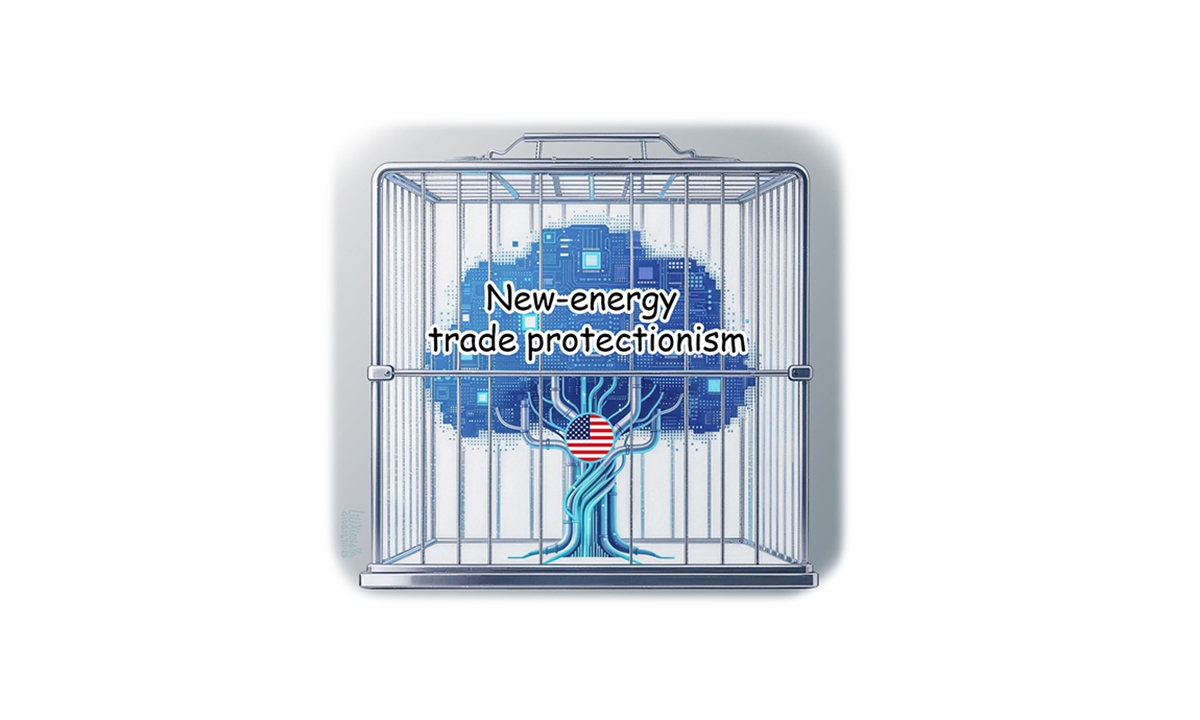
Illustration: Liu Xiangya/GT
Recent media reports have questioned whether a natural gas plant built to power an Amazon data center project in Texas could become the largest climate polluter in the US. The controversy, whatever the eventual outcome, offers a reality check for America's artificial intelligence (AI) drive.
It exposes a growing contradiction: The US is racing to expand its AI capabilities, yet its protectionist trade policies are making it harder and more costly to access some of the clean-energy technologies needed to sustain that expansion. This raises a broader question: Can an energy-intensive AI race afford the costs of renewable energy protectionism?
The US is entering a new era of rising electricity demand. Data centers, the backbone of the AI economy, are emerging as one of the fastest-growing sources of power consumption. Much of that demand is still being met by fossil fuels: The International Energy Agency reports that natural gas supplies more than 40 percent of the electricity used by data centers in the US, making it their largest source of power.
So, it's not surprising that the expansion of data centers has raised concerns over their environmental impact and the pressure they could place on local power systems and electricity bills. A Gallup survey conducted in March found that seven in 10 Americans opposed the construction of AI data centers in their local area, including 48 percent who strongly opposed such projects.
The findings point to a broader challenge for the US: The race to develop AI is increasingly becoming a race to meet growing energy needs. Addressing this challenge will require more than advances in computing technology; it will also depend on an energy system capable of delivering large amounts of reliable, affordable and cleaner power. That, in turn, will require faster development and broader deployment of clean-energy technologies, from solar power to energy storage.
Yet in the clean-energy sector, the US has increasingly relied on protectionist trade measures that limit access to cost-competitive products from global markets. The country has placed greater emphasis on expanding domestic manufacturing capacity, but rebuilding entire clean-energy supply chains at home is a costly and time-consuming process. Even if expanded domestic production is achieved, it is likely to come at a higher cost, making the deployment of renewable technologies more expensive and potentially slower.
The solar industry offers a clear illustration of this policy direction. The US has continued to expand trade barriers in the sector. Reuters reported that the US government announced on Thursday a series of price floors and a 15 percent tariff on products made from polysilicon, a raw material used in solar panels.
The challenge lies in the limited scale of the US polysilicon industry. Reuters reported that the country has two polysilicon factories. Against this backdrop, relying on domestic polysilicon production while restricting access to imports runs counter to the goal of expanding solar power in the US. The country risks creating barriers that ultimately constrain its own access to the global supply chains needed for growth.
The pressing issue for the US is the speed at which new power demand is emerging. The expansion of data centers is creating electricity needs that cannot wait for domestic clean-energy capacity to develop gradually. Global supply chains can provide the scale and speed required in the near term. By narrowing access to these sources, the US risks turning clean-energy policy into a drag on the infrastructure needed for its AI race.
The US has placed AI high on its economic and technological agenda. The outcome of this race will matter greatly, as financial markets are also watching whether America can turn its AI efforts into commercial success.
This leaves the US with a difficult choice: Can it afford the cost of clean-energy protectionism while racing to build AI infrastructure? The answer may be no. Trade barriers that limit access to competitive renewable technologies could ultimately become a constraint on the AI expansion that Washington is seeking to accelerate.
The author is a reporter with the Global Times. [email protected]
。
现年54岁的桑德伯格组织拍摄了一部名为《沉默前的尖叫》(Screams Before Silence)的纪录片,在其中她通过采访亲历者的方式,讲述了去年10月7日,当哈马斯突袭以色列南部城镇时,以色列妇女遭到的袭击和暴力。
在“退休”前,毕业月哈佛大学的桑德伯格,曾被视为硅谷最出色的女高管。她曾担任过Meta公司的首席运营官(COO),是“脸书”创始人马克·扎克伯格最器重和依赖的人,同时也是第一位在Meta董事会任职的女性,在那之前桑德伯格还曾担任过谷歌全球在线销售和运营副总裁。
2022年桑德伯格辞去了Meta COO的职务,今年1月她又宣布,不会再谋求董事会的连任。普遍认为,她是要跟自己的第三任丈夫汤姆·伯恩塔尔 (Tom Bernthal)一起,享受无人打扰的且养尊处优的生活去了,却也没想到,她拍摄了“人生中最重要的作品”(桑德伯格的原话)。
桑德伯格“主演”了已经在“油管”上播出的长达1个小时的纪录片。在其中她与音乐节上的幸存者塔利·班纳(Tali Banner)进行了交谈。塔利讲述了她如何在一辆拖车里躲了七个小时,并听到其他女性被残忍侵犯时的痛苦哭声。
桑德伯格也采访了19岁的女人质纳马·利维(Naama Levy) 的母亲阿耶莱特·利维·萨查尔 (Ayelet Levy Sachar),在听闻女孩被绑架的过程时,桑德伯格流下了眼泪。
颇为讽刺的是,桑德伯格曾花了14年的时间,与扎克伯格精诚合作,将“脸书”打造成了最强大的社交媒体平台之一,而她现在所制作的纪录片,不得不挑战在这个社交媒体上盛行的“否认主义”。
包括“脸书”在内的社交媒体上,充斥着一种论调,那就是声称桑德伯格拍摄的纪录片以及其他的揭露哈马斯暴行的消息,“都是不真实的”。此外还有人声称,哈马斯对以色列南部平民的攻击,“是受压迫人民的合法行动。”
桑德伯格称,希望学生和其他在全国各地的大学里搭建营地的抗议者,能看到这部纪录片,“他们必须看到女性所遭受的现实。”“我不认为10月7日发生的事情是合理的,但有些人坚称那是抵抗。你可以相信那是抵抗,但侵犯女性绝对不是。“